"In strategy the longest way round is often the shortest way there; a direct approach to the object exhausts the attacker and hardens the resistance by compression."
— B.H. Liddell Hart, Strategy: The Indirect Approach (1941)
Description
Domineering is a game of denial. Each domino placed not only claims territory; it poisons the squares around it, foreclosing entire classes of moves for an opponent while preserving one’s own.
Having encountered our first partisan game of perfect information in Hackenbush, the reader will find that, where Hackenbush’s partisanship was color-coded—blue for Left, red for Right, green for both—Domineering’s partisanship is purely geometric.
This geometry will reveal a hidden structure: most positions are cold numbers, their value determining the winner regardless of who moves first. Some positions, however, still may offer the first player a decisive advantage. Understanding this—the temperature of the board—is key.
History
When Swedish mathematician Göran Andersson invented the game around 1973, it wasn’t called Domineering. It was introduced to the general public by renowned math communicator Martin Gardner in his November 1974 Scientific American column under the title Crosscram. Gardner’s column, as always, sparked widespread interest among recreational mathematicians.
Once John Conway adopted the game as a textbook example for his emerging field of Combinatorial Game Theory, Domineering became famous for a remarkable property: a single game naturally breaks down during play into completely isolated, smaller sub-boards — what we now call a disjunctive sum. This decomposition allowed for the calculation of precise mathematical values for individual zones on the board, making Domineering a perfect laboratory for testing the nascent theory of surreal numbers.
In July 1994, the Mathematical Sciences Research Institute (MSRI) in Berkeley hosted a famous Domineering tournament featuring a
Because the board shrinks with every move, computer scientists soon began racing to solve the game using alpha-beta pruning and transposition tables. The results arrived in a steady march:
- In 2000, Dennis Breuker, Jos Uiterwijk, and Jaap van den Herik solved the classic
board, proving it is a guaranteed win for the first player under perfect play. - In 2002, Nathan Bullock solved the
board as part of his academic thesis. - In 2016, Jos Uiterwijk pushed the boundaries of computing by solving the
board.
Computer mapping of these solved boards revealed something surprising in the game’s mathematics. On almost all standard square layouts —
Remark.
The
Rules and Gameplay
Domineering is a two-player partisan game played on a rectangular grid of square cells. The players are Left (Vertical) and Right (Horizontal), each restricted to placing dominoes of a single orientation.
The Board. The game is played on a rectangular grid of square cells, typically of size
Legal Moves. A move consists of placing an (indivisible) domino covering two adjacent empty cells. Left may place a domino vertically over two cells that share a horizontal edge. Right may place a domino horizontally over two cells that share a vertical edge. Once a cell is covered, it remains occupied for the remainder of the game. No domino may overlap with another, and dominoes may not be moved or removed.
Turn Order and Passing. Players alternate moves. Left traditionally moves first, though this convention is not mathematically mandatory. Passing is prohibited: a player with at least one legal move must make one.
Termination and Victory. The game is finite: each move reduces the number of empty cells by exactly two. Play continues under the normal play convention: the player who makes the final legal move wins. If a player has no legal move on their turn, they lose immediately. No draw is possible.
Mathematics of Domineering
Partisan Games and the Need for Surreal Numbers
Having already encountered partisan games in Hackenbush, the reader will recall that not every game can be analyzed using the Sprague-Grundy theory. In impartial games such as Nim or Dawson’s Kayles, the set of legal moves available to Left is identical to that available to Right. This symmetry allows us to assign a single nim-value to each position, and the outcome of a sum of games is determined by the nim-sum of their components.
Domineering has no such symmetry. Left may only place dominoes vertically and, Right, only horizontally. From a given position, Left’s available moves are generally disjoint from Right’s. A winning position for Left may be a losing one for Right, and vice versa. No single nim-value can capture this asymmetry.
To see why, consider a simple
Symmetrically, a
Now, consider the simplest nontrivial Domineering position: a
Conway called this a switch, and denoted it
What if we alter the board slightly? Consider a 3-cell “L” tromino (a
which is exactly the nim-value
This example illustrates a central insight: Domineering positions are naturally represented as surreal numbers (or, more generally, games) in the sense of Conway. A position
where
For a Domineering position
This recursive definition is valid since every move reduces the number of empty cells by exactly two, ensuring well-foundedness. The terminal position—an empty board with no moves for either player—has value
In the sequel, we say that
- every Left option
and every Right option are themselves numbers, and - every Left option is strictly less than every Right option:
When this condition holds, by the Simplicity Rule established in the previous chapter,
As we have already seen in Hackenbush, the arithmetic of these values follows the rules of surreal numbers. Two positions are equivalent if their game values are equal in the surreal sense:
Domineering, however, has a remarkable property regarding how a single game evolves: while the initial empty boards are hot (producing complex switches like
Remark.
The phrase “cold” refers to positions whose values are numbers. Such positions are cold in the sense that neither player has an incentive to race there: the value of the position is already determined, and any move would only make it worse for the moving player. Hot positions, by contrast, are those where the first player has a decisive advantage—values that are not numbers, such as switches
The Coldness Theorem
We now come to one of Domineering’s most fundamental structural properties. Despite partisan asymmetry giving rise to hot switches such as
Theorem (Algebraic Coldness).
Let
holds for all Left options
Proof.
Since
(If Left has no moves, we consider
By our hypothesis, the strict ordering condition holds, meaning
Since
Notice that
Therefore, by the Simplicity Rule,
The Coldness Theorem reduces the question of whether a position is a number to an algebraic check, but for an arbitrary Domineering position, this condition may fail—recall, for example, the
Corollary (Geometric Coldness).
If a Domineering position
Proof.
We proceed by induction on the number of empty cells in
Base Case: The empty board has no legal moves for either player, evaluating to
Inductive Hypothesis: Assume the theorem holds for all positions having fewer empty cells than
Notice that any move from
It remains to verify the ordering condition. Let
Since
By the Algebraic Coldness Theorem,
Remark.
The Geometric Coldness Corollary is the heart of Domineering’s endgame theory. While the early game may be hot—contested regions where vertical and horizontal moves compete for the same cells—the late game inevitably fragments into isolated strips. Once this fragmentation occurs, all remaining positions are cold numbers, and the winner is determined solely by the sum of their values. This is why Domineering, despite its partisan origins, is ultimately a game of calculation.
Values of Small Rectangles
With the Coldness Theorem at hand we can now compute exact values for several fundamental positions. These values will serve as building blocks for larger boards and for evaluating endgame positions.
The
The simplest family of positions are the
Let
(empty board). (a single isolated cell; no moves for either player). (Right has one horizontal move, leaving an empty board).
Notice that on a
This pattern holds in general. In a
The value, then, of any
Similarly, as an
The
Expanding to a width of two introduces shared space and significantly complicates calculation, as moves now conflict. We have already established the values for small iterations:
The
- playing on either end, which leaves a
block (value ), or - playing in the center, which leaves two isolated
strips (value ).
Right’s horizontal moves each leave an asymmetric
Since Left prefers
Notice that Left’s option (evaluating to
The
Since the
Notice that the symmetry reduces Left’s choices to just two essentially distinct vertical moves: playing in an outer column, or playing in the middle column. If Left plays in an outer column, it leaves a massive contiguous block of empty cells for Right.
However, if Left plays in the center column (covering, say, the top two cells), the domino acts as a wall. It bisects the upper portion of the board, completely severing Right’s ability to play across the top two rows, while simultaneously preserving two vertical columns for its own use.
Evaluating this strategically bisected subgame yields a value of exactly
This is a switch, but cooler than both the
We call this advantage the temperature. The
The
As we mentioned earlier, square boards almost universally favor the first player. The intuition is straightforward: on a highly contested, symmetric grid, the player who places the first domino establishes the initial temperature, and dictates the pace of the game’s fragmentation.
However, the
To understand why this board is an exception, we consider a symmetric pairing strategy.
Since a square board is symmetric across its main diagonal, there exists a natural mapping between Left’s vertical moves and Right’s horizontal moves. If we label cells using coordinates
The symmetry across the diagonal guarantees Right has a response to any off-diagonal move by Left. If this pairing held universally, Right would inevitably make the last move, securing a second-player win on any square board. The strategy breaks down, however, when players do play on the diagonal.
Any domino intersecting the main diagonal covers exactly one diagonal cell and one off-diagonal cell. If Left places a vertical domino covering, for example,
Coming back to the anomaly, on a
Exhaustive game-tree searches [Breuker00, Bullock02] have confirmed that Left simply does not have enough diagonal space to overcome Right’s relentless mirroring. Right can absorb Left’s limited diagonal disruptions, adjust their pairing, and inevitably exhaust Left’s moves.
Disjunctive Sums and Endgame Evaluation
As we saw in Chapter 6, positions that fracture into independent components form a disjunctive sum. The value of such a sum is the sum of its components computed in the surreal sense.
This additivity is the engine that makes Domineering’s endgame tractable. Once the board has fractured into isolated strips, the value of each strip can be computed independently and then summed disjunctively.
Consider, for example, a position consisting of two isolated
This means Right has two free moves; Left has none. Right will win regardless of who moves first.
A more interesting example is a
This position is still a hot game, but notice what has happened. The temperature remains exactly
Computational Complexity
Despite the elegant mathematical structure of the endgame, determining the winner from an arbitrary position is computationally intractable. Domineering is known to be PSPACE-complete, even on boards of dimension
This means that no polynomial-time algorithm is known (or expected) to solve Domineering in general. The game tree grows exponentially with the board size, and the partisan nature of the game prevents simpler nim-sum analyses that work for impartial games.
Such complexity justifies the use of search algorithms for larger boards. While the theory gives us exact values for isolated strips and small rectangles, arbitrary positions will require computational exploration. The search algorithms presented in the following section---using alpha-beta pruning and transposition tables---are the practical tools that bring the mathematics to life.
Remark.
The PSPACE-completeness of Domineering is one of its most fascinating features. Despite being “mostly cold”, the problem of determining the winner remains hard in the worst case. This tension between mathematical tractability in the endgame and computational intractability in general has been a recurring theme in combinatorial game theory.
Example of Gameplay
To illustrate the mathematical principles developed in this chapter, we walk through a concrete position. Consider the
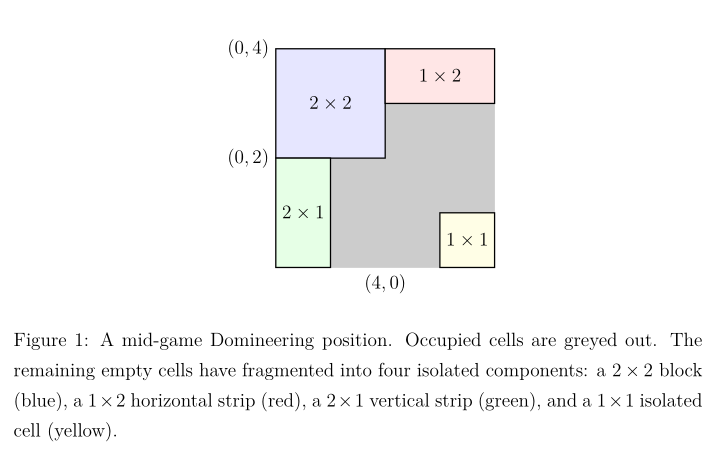
The total value of the position is the sum of its components:
This is a hot game: the first player to move will win by playing in the
We now walk through optimal play.
Move 1: Left’s Opening
Left (vertical) correctly identifies the
The position is now a number (cold), with value
Move 2: Right’s Response
Right (horizontal) now has no hot move. Right plays a horizontal domino in the
Move 3: Left’s Response
Left plays in one of the
Move 4: Right’s Response
Right now has no legal move as the only remaining components are the
Thus, Right has no legal moves and (under normal play) Left wins.
Remark.
This example demonstrates the key strategic insight of Domineering: identify hot components and play in them first. Cold components can be safely ignored until the hot components are resolved. The arithmetic of surreal numbers provides the exact calculations justifying this strategy.
Domineering in Command Line (with Lisp for game engines)
Algorithmic Application: Minimax in a Partisan Context
The minimax algorithm and alpha-beta pruning were established in the Chapter 4. While the underlying tree-search mechanism remains identical, Domineering requires a conceptual shift in how we evaluate game states and generate branches due to its partisan nature.
Unlike impartial games where both players share the same available moves, Domineering assigns mutually exclusive move sets where Left (vertical) places
To navigate the game tree effectively, our alpha-beta implementation relies on a specific evaluation function:
- Mobility Heuristic: Instead of counting discrete points or boxes, the evaluation function calculates the difference in available legal moves. If
is the number of valid vertical moves and is the number of valid horizontal moves, the board value for Left is . - Zero-Sum Dynamics: Every domino placed by Left consumes two squares. This may simultaneously reduce
(by taking up vertical space) and reduce (by blocking horizontal placements). The AI seeks moves that maximize the destruction of the opponent’s move space while preserving its own.
Example (Pruning in Domineering).
Consider a position where Left (maximizer) has found a move sequence that guarantees a mobility advantage of +2 (
Architectural Overview
Our Domineering implementation maintains a hybrid scripting architecture, customized for real-time visual output:
- Bash (Game Orchestration): Manages the terminal interface, controls the game loop, and handles the continuous rendering of the board state to a standalone SVG viewer.
- Common Lisp (The Engine): Receives board dimensions and difficulty parameters to execute the core game logic.
- Strategic Foundation: The AI utilizes:
- Move validation and asymmetric move generation.
- State manipulation via
apply-moveandundo-moveto traverse the game tree without duplicating the board array in memory. - Alpha-beta pruning recursively projecting game states up to a depth of
(note that this is set by default to ), dynamically evaluating mobility to force the opponent into starvation.
Remark (Practical Implementation).
Since an
Game Orchestration (Bash)
The Bash component manages the user interface (where input is command line and output is an svg file) and menus where the player may make such choices as diffilculty level, board size, etc.
#!/bin/bash
cd "$(dirname "$0")" || exit 1

# ANSI Color Codes
BLUE='\033[1;34m'
RED='\033[1;31m'
GREEN='\033[1;32m'
YELLOW='\033[1;33m'
CYAN='\033[1;36m'
NC='\033[0m' # No Color

# initial State
BOARD_SIZE=5
DIFFICULTY="Medium"
SEARCH_DEPTH="1"
PLAYER_TURN="First" # options: First, Second, Random

# clear screen function
clear_screen() {
    printf "\033c"
}

# print the header
print_header() {
    echo -e "${CYAN}=========================================${NC}"
    echo -e "${CYAN}       D O M I N E E R I N G             ${NC}"
    echo -e "${CYAN}=========================================${NC}"
    echo -e "Board Size: ${YELLOW}${BOARD_SIZE}x${BOARD_SIZE}${NC} | Difficulty: ${YELLOW}${DIFFICULTY}${NC} (Depth ${SEARCH_DEPTH})"
    echo -e "Human Plays: ${YELLOW}${PLAYER_TURN}${NC}"
    echo -e "${CYAN}-----------------------------------------${NC}"
}

# launch game
start_game() {
    clear_screen
    echo -e "${GREEN}Initializing Lisp Engine...${NC}"
    echo -e "Starting ${BOARD_SIZE}x${BOARD_SIZE} board at Depth ${SEARCH_DEPTH}."
    echo -e "Watch the eog window for the board state!\n"

    # touch SVG file so eog can open immediately
    rm -f current_board.svg
    touch current_board.svg

    # launch eog in background. (eog auto-reloads when file changes)
    eog current_board.svg > eog_error.log 2>&1 &
    EOG_PID=$!

    # translate ACTUAL_TURN string into numeric human player ID
    HUMAN_PLAYER=1
    if [ "$ACTUAL_TURN" == "Second" ]; then
        HUMAN_PLAYER=2
    fi

    # translate DIFFICULTY string to numeric ID (1=Easy, 2=Medium, 3=Hard)
    DIFF_NUM=2
    if [ "$DIFFICULTY" == "Easy" ]; then DIFF_NUM=1; fi
    if [ "$DIFFICULTY" == "Hard" ]; then DIFF_NUM=3; fi

    # Left (Player 1) ALWAYS makes first move
    START_PLAYER=1

    # pass control to Lisp engine
    echo -e "${YELLOW}Enter your moves as two coordinates (e.g., C2 C3).${NC}"
    echo -e "${YELLOW}Press Ctrl+D when you are ready to end the game.${NC}\n"

    # pass ALL 4 argumehnts to Lisp engine
    sbcl --script domineering-engine.lisp $BOARD_SIZE $START_PLAYER $DIFF_NUM $HUMAN_PLAYER 2> engine_error.log

    # when Lisp engine exits (via Ctrl+D or game over), kill eog viewer
    kill $EOG_PID 2>/dev/null

    echo -e "\n${GREEN}Game Over!${NC}"
    # pause and wait for user to hit Enter before clearing screen
    read -p "Press Enter to return to the main menu..."

    sleep 2
}

# main menu loop
while true; do
    clear_screen
    print_header
    echo "1) Start Game"
    echo "2) Set Board Size"
    echo "3) Set Difficulty"
    echo "4) Set Player Turn"
    echo "5) Exit"
    echo -e "${CYAN}-----------------------------------------${NC}"
    read -p "Select an option [1-5]: " choice

    case $choice in
        1)
            # handle random coin flip right before start
            ACTUAL_TURN=$PLAYER_TURN
            if [ "$ACTUAL_TURN" == "Random" ]; then
                if [ $((RANDOM % 2)) -eq 0 ]; then
                    ACTUAL_TURN="First"
                else
                    ACTUAL_TURN="Second"
                fi
                echo -e "${GREEN}Random selection: You are going ${ACTUAL_TURN}!${NC}"
                sleep 2
            fi

            # pass $ACTUAL_TURN to start_game function/Lisp engine here
            start_game
            ;;
        2)
            echo -e "\n${YELLOW}Select Board Size:${NC}"
            echo "1) 5x5 (The Anomaly)"
            echo "2) 6x6"
            echo "3) 8x8"
            read -p "Choice [1-3]: " size_choice
            case $size_choice in
                1) BOARD_SIZE=5 ;;
                2) BOARD_SIZE=6 ;;
                3) BOARD_SIZE=8 ;;
            esac
            ;;
        3)
            echo -e "\n${YELLOW}Select Difficulty:${NC}"
            echo "1) Easy   (Random)"
            echo "2) Medium (1-Move Lookahead)"
            echo "3) Hard   (Depth 3)"
            read -p "Choice [1-3]: " diff_choice
            case $diff_choice in
                1) DIFFICULTY="Easy"; SEARCH_DEPTH="N/A" ;;
                2) DIFFICULTY="Medium"; SEARCH_DEPTH="1" ;;
                3) DIFFICULTY="Hard"; SEARCH_DEPTH="3" ;;
            esac
            ;;
        4)
            echo -e "\n${YELLOW}Select Who Goes First:${NC}"
            echo "1) Human goes First (Left/Vertical)"
            echo "2) Human goes Second (Right/Horizontal)"
            echo "3) Randomize"
            read -p "Choice [1-3]: " turn_choice
            case $turn_choice in
                1) PLAYER_TURN="First" ;;
                2) PLAYER_TURN="Second" ;;
                3) PLAYER_TURN="Random" ;;
            esac
            ;;
        5)
            echo -e "${GREEN}Exiting. Goodbye!${NC}"
            exit 0
            ;;
        *)
            echo -e "${RED}Invalid option.${NC}"
            sleep 1
            ;;
    esac
done
AI Engine (Common Lisp)
The Lisp component handles game flow, state managemant, the building of boards, and the strategic AI using the minimax algorithm with alpha-beta pruning.
;;; domineering-engine.lisp
;;; run with: sbcl --script domineering-engine.lisp [SIZE] [START] [DIFF] [HUMAN]

(defparameter *cell-size* 60)
(defparameter *offset* 40)
(defparameter *board* nil)
(defparameter *rows* 0)
(defparameter *cols* 0)

(defun init-board (r c)
  (setf *rows* r
        *cols* c
        *board* (make-array (list r c) :initial-element 0)))

(defun get-color (val)
  (case val
    (0 "#ffffff") ; Empty
    (1 "#6464ff") ; Left (Blue)
    (2 "#ff6464") ; Right (Red)
    (t "#cccccc")))

(defun draw-svg-board (filename &optional game-over-msg)
  "Builds SVG, writes to temp file, and uses native SBCL mv for atomic updates."
  (let* ((padding 15)
         (width (+ *offset* (* *cols* *cell-size*) padding))
         (height (+ *offset* (* *rows* *cell-size*) padding))
         (temp-filename (concatenate 'string filename ".tmp"))
         (svg-data
          (with-output-to-string (stream)
            (format stream "<svg xmlns='http://www.w3.org/2000/svg' width='~A' height='~A'>~%" width height)
            (format stream "<style>text { font-family: monospace; font-size: 18px; text-anchor: middle; dominant-baseline: middle; fill: #333; }</style>~%")
            (format stream "<rect width='100%' height='100%' fill='#ffffff'/>~%")

            (dotimes (c *cols*)
              (let ((char-label (code-char (+ (char-code #\A) c)))
                    (x (+ *offset* (* c *cell-size*) (/ *cell-size* 2)))
                    (y (/ *offset* 2)))
                (format stream "<text x='~A' y='~A'>~A</text>~%" x y char-label)))

            (dotimes (r *rows*)
              (let ((x (/ *offset* 2))
                    (y (+ *offset* (* r *cell-size*) (/ *cell-size* 2))))
                (format stream "<text x='~A' y='~A'>~A</text>~%" x y (1+ r))))

            (dotimes (r *rows*)
              (dotimes (c *cols*)
                (let ((val (aref *board* r c))
                      (x (+ *offset* (* c *cell-size*)))
                      (y (+ *offset* (* r *cell-size*))))
                  (format stream "<rect x='~A' y='~A' width='~A' height='~A' fill='~A' stroke='#333' stroke-width='2'/>~%"
                          x y *cell-size* *cell-size* (get-color val)))))

            (when game-over-msg
              (let ((box-w 280) (box-h 60))
                (format stream "<rect x='~A' y='~A' width='~A' height='~A' fill='black' opacity='0.85' rx='8'/>~%"
                        (- (/ width 2) (/ box-w 2)) (- (/ height 2) (/ box-h 2)) box-w box-h)
                (format stream "<text x='~A' y='~A' font-size='22' fill='white' font-weight='bold'>~A</text>~%"
                        (/ width 2) (+ (/ height 2) 2) game-over-msg)))

            (format stream "</svg>~%"))))

    ;; 1. write fully complete SVG to temporary file
    (with-open-file (out temp-filename :direction :output :if-exists :supersede :if-does-not-exist :create)
      (write-string svg-data out))

    ;; 2. atomic rename using SBCL's native program runner
    (sb-ext:run-program "mv" (list temp-filename filename) :search t)))

;;; ==========================================
;;; AI OPPONENT LOGIC
;;; ==========================================
(setf *random-state* (make-random-state t))

(defun get-valid-moves (player)
  (let ((moves nil))
    (dotimes (r *rows*)
      (dotimes (c *cols*)
        (if (= player 1)
            (when (valid-move-p r c (1+ r) c player)
              (push (list r c (1+ r) c) moves))
            (when (valid-move-p r c r (1+ c) player)
              (push (list r c r (1+ c)) moves)))))
    moves))

(defun apply-move (move player)
  (setf (aref *board* (first move) (second move)) player)
  (setf (aref *board* (third move) (fourth move)) player))

(defun undo-move (move)
  (setf (aref *board* (first move) (second move)) 0)
  (setf (aref *board* (third move) (fourth move)) 0))

(defun format-move (move)
  (let ((c1-char (code-char (+ (second move) (char-code #\A))))
        (r1-num (1+ (first move)))
        (c2-char (code-char (+ (fourth move) (char-code #\A))))
        (r2-num (1+ (third move))))
    (format nil "~A~A ~A~A" c1-char r1-num c2-char r2-num)))

(defun easy-ai-move (player)
  (let ((moves (get-valid-moves player)))
    (when moves (nth (random (length moves)) moves))))

(defun evaluate-mobility (player)
  (let ((opponent (if (= player 1) 2 1)))
    (- (length (get-valid-moves player))
       (length (get-valid-moves opponent)))))

(defun medium-ai-move (player)
  (let ((moves (get-valid-moves player))
        (best-score -9999)
        (best-moves nil))
    (dolist (m moves)
      (apply-move m player)
      (let ((score (evaluate-mobility player)))
        (undo-move m)
        (cond ((> score best-score)
               (setf best-score score)
               (setf best-moves (list m)))
              ((= score best-score)
               (push m best-moves)))))
    (when best-moves (nth (random (length best-moves)) best-moves))))

;; --- PASTE THE NEW CODES HERE ---

(defun alpha-beta-search (depth current-player alpha beta ai-player)
  "Recursive Alpha-Beta evaluation. Tracks the board state relative to ai-player."
  (let ((moves (get-valid-moves current-player)))
    (cond
      ((or (= depth 0) (null moves))
       (evaluate-mobility ai-player))
      ((= current-player ai-player)
       (let ((max-eval -9999))
         (dolist (m moves max-eval)
           (apply-move m current-player)
           (let ((score (alpha-beta-search (1- depth)
                                           (if (= current-player 1) 2 1)
                                           alpha beta ai-player)))
             (undo-move m)
             (setf max-eval (max max-eval score))
             (setf alpha (max alpha score))
             (when (>= alpha beta)
               (return max-eval))))))
      (t
       (let ((min-eval 9999))
         (dolist (m moves min-eval)
           (apply-move m current-player)
           (let ((score (alpha-beta-search (1- depth)
                                           (if (= current-player 1) 2 1)
                                           alpha beta ai-player)))
             (undo-move m)
             (setf min-eval (min min-eval score))
             (setf beta (min beta score))
             (when (>= alpha beta)
               (return min-eval)))))))))

(defun hard-ai-move (player)
  "Advanced AI choice using standard alpha-beta pruning lookahead."
  (let ((moves (get-valid-moves player))
        (best-score -9999)
        (best-moves nil)
        (search-depth 3))
    (dolist (m moves)
      (apply-move m player)
      (let ((score (alpha-beta-search (1- search-depth)
                                      (if (= player 1) 2 1)
                                      -9999 9999 player)))
        (undo-move m)
        (cond ((> score best-score)
               (setf best-score score)
               (setf best-moves (list m)))
              ((= score best-score)
               (push m best-moves)))))
    (when best-moves (nth (random (length best-moves)) best-moves))))

;;; ==========================================
;;; PARSER AND GAME LOOP
;;; ==========================================
(defun parse-coord (coord-str)
  (let* ((coord (string-trim " " (string-upcase coord-str)))
         (col-char (char coord 0))
         (col (- (char-code col-char) (char-code #\A)))
         (row-str (subseq coord 1))
         (row (1- (parse-integer row-str))))
    (list row col)))

(defun valid-move-p (r1 c1 r2 c2 player)
  (and (>= r1 0) (< r1 *rows*) (>= c1 0) (< c1 *cols*)
       (>= r2 0) (< r2 *rows*) (>= c2 0) (< c2 *cols*)
       (= (aref *board* r1 c1) 0)
       (= (aref *board* r2 c2) 0)
       (if (= player 1)
           (and (= c1 c2) (= (abs (- r1 r2)) 1))
           (and (= r1 r2) (= (abs (- c1 c2)) 1)))))

(defun process-move (input-string player)
  (handler-case
      (let* ((clean-input (string-trim " " input-string))
             (space-pos (position #\Space clean-input)))
        (if (not space-pos)
            (format t "ERROR: Need two coordinates separated by a space (e.g., A1 A2).~%")
            (let* ((coord1 (subseq clean-input 0 space-pos))
                   (coord2 (subseq clean-input (1+ space-pos)))
                   (pos1 (parse-coord coord1))
                   (pos2 (parse-coord coord2))
                   (r1 (first pos1)) (c1 (second pos1))
                   (r2 (first pos2)) (c2 (second pos2)))
              (if (valid-move-p r1 c1 r2 c2 player)
                  (progn
                    (setf (aref *board* r1 c1) player)
                    (setf (aref *board* r2 c2) player)
                    (format t "SUCCESS~%"))
                  (format t "ERROR: Invalid move. Check rules and bounds.~%")))))
    (error (c)
      (format t "ERROR: Syntax not recognized. Try exactly A1 A2.~%"))))

(defun main-loop (size starting-player difficulty human-player)
  (init-board size size)
  (draw-svg-board "current_board.svg")

  (let ((current-player starting-player))
    (loop
      (finish-output)

      ;; WIN CONDITION CHECK
      (unless (get-valid-moves current-player)
        (let ((msg (if (= current-player human-player) "GAME OVER: AI WINS" "GAME OVER: YOU WIN")))
          (draw-svg-board "current_board.svg" msg)
          (format t "~%>>> ~A <<<~%" msg)
          (finish-output)
          (sleep 3)
          (sb-ext:exit :code 0)))

      ;; TAKE TURN
      (if (and (> difficulty 0) (/= current-player human-player))
          (progn
            (let ((move (cond ((= difficulty 1) (easy-ai-move current-player))
                              ((= difficulty 2) (medium-ai-move current-player))
                              ((= difficulty 3) (hard-ai-move current-player)))))
              (apply-move move current-player)
              (draw-svg-board "current_board.svg")
              (sleep 0.1) ; <--- ADDED: Gives eog time to render AI move
              (format t "~%>>> AI played: ~A~%" (format-move move))
              (setf current-player (if (= current-player 1) 2 1))))

          (progn
            ;; HUMAN PROMPT
            (format t "~%Your turn (~A) [e.g. A1 A2]: " (if (= current-player 1) "Blue/Vertical" "Red/Horizontal"))
            (finish-output)

            (let ((input (read-line nil nil :eof)))
              (when (eq input :eof) (return))
              (let ((result (with-output-to-string (*standard-output*)
                              (process-move input current-player))))
                (if (search "SUCCESS" result)
                    (progn
                      (draw-svg-board "current_board.svg")
                      (sleep 0.1) ; <--- ADDED: Gives eog time to render Human move
                      (setf current-player (if (= current-player 1) 2 1)))
                    (format t "~A" result)))))))))

;;; ==========================================
;;; SCRIPT ENTRY POINT
;;; ==========================================
(let ((args sb-ext:*posix-argv*))
  (if (>= (length args) 5)
      (let ((size (parse-integer (nth 1 args)))
            (start-player (parse-integer (nth 2 args)))
            (difficulty (parse-integer (nth 3 args)))
            (human-player (parse-integer (nth 4 args))))
        (main-loop size start-player difficulty human-player))
      (format t "ERROR: Missing args. Expected: size start_player difficulty human_player~%")))
References:
- Berlekamp, E. R., Conway, J. H., and Guy, R. K. (1982). Winning Ways for your Mathematical Plays, volumes 1 and 2. Academic Press, London.
- Breuker, D. M., Uiterwijk, J. W. H. M., and van den Herik, H. J. (2000). Solving
Domineering. Theoretical Computer Science, 230(1-2):195–206. - Bullock, N. (2002). Domineering: Solving Large Combinatorial Search Spaces. Master’s thesis, University of Alberta.
- Lachmann, M., Moore, C., and Rapaport, I. (2000). Who wins Domineering is PSPACE-complete. Theoretical Computer Science, 246(1-2):283–300.